As
Indonesia prepares to elect a new parliament and president in the coming
months, DW examines how political graft is undermining the Southeast Asian
country's democratic and economic achievements of the past decade.

Many analysts regard Indonesia's accomplishments after the overthrow of longstanding authoritarian ruler Suharto in 1998 as remarkable. The world's largest Muslim democracy with more than 250 million people has not only managed to expand its economy at an average rate of 5.5 percent over the past decade. It has also undertaken "one of the most ambitious institutional reform programs attempted anywhere," by rapidly decentralizing power, creating a constitutional court and a powerful anti-corruption commission," according to the US-based National Democratic Institute (NDI).
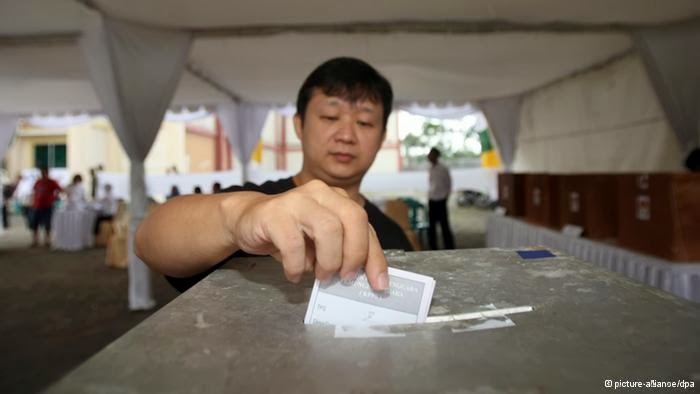
Many analysts regard Indonesia's accomplishments after the overthrow of longstanding authoritarian ruler Suharto in 1998 as remarkable. The world's largest Muslim democracy with more than 250 million people has not only managed to expand its economy at an average rate of 5.5 percent over the past decade. It has also undertaken "one of the most ambitious institutional reform programs attempted anywhere," by rapidly decentralizing power, creating a constitutional court and a powerful anti-corruption commission," according to the US-based National Democratic Institute (NDI).
By the time
the term of incumbent President Susilo Bambang Yudhoyono ends this year, the
country "will have witnessed its first 10-year stretch of both democracy
and stability," says Sandra Hamid, The Asia Foundation's Country
Representative in Indonesia.
Money
politics
But despite
the many achievements, experts say Indonesia is still in a state of transition
to a mature democracy which may be threatened by the rampant corruption that
has been plaguing the country over the past years. The Southeast Asian nation
ranked 114th out of 177 countries in Transparency International's 2013
Corruption Perception Index, with number one being perceived as the least
corrupt.
"With
very little influence and a thin base of supporters, it is public knowledge
that a number of political parties and candidates running for office have
resorted to money politics to secure votes," says Hamid.
The analyst
explains that rather than running on fresh ideas and campaigning strategically,
many competing parties have chosen to entertain voters with live music, free
t-shirts, and even offering money.
"More
than 35 percent of voters confessed that they, or their families, had
experienced vote buying," Hamid said. "And when vote-buying alone
isn't enough to secure votes, funds have been directed to the judiciary,"
she added, referring to the arrest of the former chief justice of the
Constitutional Court.
A pervasive
practice?
In early
February, Akil Mochtar went on trial on charges of corruption and money
laundering. Prosecutors accused the former judge of having received 57 billion
rupiah (4.8 million USD) in bribe money in exchange for fixing the results of
11 local elections.
 |
| Hamid: "A number of parties and candidates running for office have resorted to money politics to secure votes" |
The
official told state news agency Antara that the number of governors, district
chiefs and mayors arrested for corruption had increased sharply since the
introduction of direct elections for governors, district chiefs and mayors nine
years ago.
Crucial
elections
In light of
this development, there are growing fears that political corruption might soar
even further, as the country prepares to elect a new parliament and a successor
for President Yudhoyono in the coming months.
NDI Senior
Program Officer David Caragliano argues in a recently published article on that
with no clear presidential front-runner and a higher parliamentary threshold
for parties to enter the national legislature, the elections could be the most
closely contested in the nation's history. Therefore, he argues, "the
incentives for increased electoral manipulation, vote buying and fraud are
clear, at a time when the independence and competence of electoral administrative
bodies are increasingly under question."
Indonesia
has raised the bar for participating in the elections which has resulted in the
number of political parties eligible to contest dropping from 48 in 1999 to
currently 12. On April 9, some 190 million Indonesians will have a chance to
elect their legislators to more than 19,000 seats at national, provincial and
district level from these dozen political parties.
 |
| The successor for President Susilo Bambang Yudhoyono is set to be elected on July 9 |
The results
of this vote will be crucial for the presidential election, set to be held exactly
three months later on July 9, as only parties that win at least 20 percent of
the vote in the legislative polls are allowed to nominate a presidential
candidate.
Dodgy
dealings
Indonesia
expert Hamid explains that the generally weak ties between parties and
constituents make it hard for political parties to raise funds from its
members. Although regulations on party financing exist, putting them in
practice and advocating for transparency have been the biggest challenge to
date, the analyst told DW.
Several
studies have begun to shed light on the intricate relationship between
political fund raising and corrupt practices of parties when they come to
power. Ibrahim Fahmy, program director at Transparency International Indonesia,
gives an example of how this works.
"Some
big corporations lobby members of parliament who then accept bribes in exchange
for granting projects." In other cases, he adds, some political parties
will backup politically affiliated contractors and then embezzle funds to
finance big events such as national political party congresses.
A chance to
'clean up'
Given these
dodgy dealings Hamid argues that voters are seeking candidates in the upcoming
polls who are serious about fighting graft. "Newly elected officials will
have to show that they are committed to supporting the widely supported
anti-corruption agency, KPK."
 |
| Analysts say that especially young voters want to elect candidates on promises to clean up the system |
"Corruption
is a prominent part of politics in Indonesia, but an increasingly young, savvy,
and democratic populace is getting fed up, and will elect candidates on
promises to clean up the system," Poling said.
No comments:
Post a Comment
Note: Only a member of this blog may post a comment.