President
Joko Widodo holds a press conference at the State Palace but mentions nothing
about forming an independent fact-finding team consisting of law experts to
scrutinize the thinly veiled criminalization of KPK leaders
 |
Some activists demonstrate against the detainment of KPK deputy chairman
Bambang Widjojanto by the National Police at KPK’s building in Jakarta
on Jan. 23, 2015. (Antara Photo/Ismar Patrizki) |
Jakarta.
Protests are mounting against what some observers increasingly believe now to
be systematic efforts to incapacitate the Corruption Eradication Commission —
Indonesia’s last bastion of hope against systemic corruption — which seems to
have been cast adrift now with only the public as its faithful ally.
Allegations
of attempts to “criminalize” the antigraft body, known as the KPK, became
louder over the weekend as a second deputy chief of the commission was suddenly
reported to police over an old case.
Adnan Pandu
Praja was reported for alleged ownership of illegal shares in Desy Timber, a
company operating in Berau, East Kalimantan.
“We have
brought data of the crimes he committed in Berau. He stole from a family
company,” the company’s lawyer, Mukhlis Ramlan, said shortly before filing the
report to the National Police’s criminal investigation unit at the police
headquarters in South Jakarta on Saturday.
Mukhlis
accused Adnan, who served as a lawyer for Desy in 2006, of illegally taking
over 85 percent of shares in the company while the management was involved in a
family feud.
Adnan on
Sunday denied the allegations, calling them an attempt to undermine the
institution he now works with.
“Now it’s
my turn to be reported to the police,” Adnan said in a speech before a large
crowd that gathered to voice their support for the KPK on Jalan Sudirman in
Central Jakarta on Sunday, as quoted by Tempo.co.
“If I must
go through what B.W. [another KPK deputy chief, Bambang Widjojanto] did, then
that’s the cost of fighting corruption in Indonesia,” he added.
Adnan was
reported to police just a day after Bambang’s arrest on Friday in connection
with a refiled perjury complaint dating back to 2010. That case had been
dropped by the police after the Constitutional Court ruled on the regional
election dispute at the center of the case, but was recently refiled by
Indonesian Democratic Party of Struggle (PDI-P) politician Sugianto Sabran.
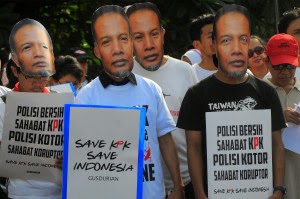 |
Some activists wear masks of KPK deputy
chairman Bambang Widjojanto in a ‘Save
KPK’ demonstration in Jakarta on Jan. 25,
2015. (Antara Photo/Zabur Karuru) |
Bambang was
given a conditional release several hours later, after widespread public
protest against his arrest and calls for support for the KPK.
Adnan, who
joined the KPK in 2013, alleged that the old case against him was dug up to
weaken the KPK, noting that he had already clarified the matter during his
vetting before the House of Representatives.
The two old
cases were filed out of the blue against the two KPK leaders following the
antigraft body’s naming of police general Comr. Gen. Budi Gunawan as a suspect
over his suspiciously hefty personal bank accounts.
The
suspicion was first flagged by the government’s anti-money-laundering watchdog,
the Financial Transaction Reports and Analysis Center, or PPATK, in 2010. The
KPK also reportedly issued a red flag against Budi when President Joko Widodo
mulled recruiting him as a member of his cabinet prior to his announcement of
the cabinet lineup in late October last year.
It was only
early this month, however, that the KPK decided to name Budi a suspect, alarmed
by the president’s nomination of him as the sole candidate for National Police
chief.
But despite
the KPK’s announcement of Budi’s suspect status earlier this month, Joko did
not retract his nomination and the House nearly unanimously — with the
Democratic Party as the only exception — endorsing Budi’s nomination just a day
after he was charged. Only after a public backlash did Joko finally say he was
postponing, though not scrapping, Budi’s nomination.
Critics
have lambasted the president for allegedly bowing to the pressure from his
party patron, PDI-P chairwoman and former president Megawati Soekarnoputri.
Budi is known to be close to Megawati, having served as her security aide
during her presidency from 2001 to 2004.
Besides the
legal issues faced by Bambang and Adnan, KPK chairman Abraham Samad has also
faced mounting attempts at character assassination.
Photos of
him in intimate poses with the current Miss Indonesia, Elvira Devinamira, began
circulating on the Internet as soon as Budi’s suspect status was announced.
Most experts have dismissed the pictures as doctored, although
less-knowledgeable people have accepted them as genuine.
In the past
week, PDI-P acting secretary general Hasto Kristiyanto, a close adviser to
Joko, accused Abraham of naming Budi a suspect out of spite.
Hasto
claimed that Abraham had a personal vendetta against the party for its decision
not to support his reported bid to be picked as Joko’s running mate in last
year’s presidential election.
BLBI
linked?
Antigraft
activist Adhie Massardi said on Sunday that the whole mess was not limited to
the long-running hostilities between the KPK and the police but stemmed from
the PDI-P’s fears that its chairwoman would be the target of a KPK probe.
Adhie
accused the PDI-P of trying to weaken the KPK and criminalize its leaders in
the wake of an investigation into alleged irregularities in the issuance of
letters of discharge for Bank Indonesia Liquidity Support (BLBI) debtors in
2002.
Adhie, from
the Clean Indonesia Movement, said the PDI-P’s elites were concerned that the
probe would settle on Megawati, who as president during that period approved
the issuance of the letters.
A total of
Rp 144.5 trillion ($12 billion) of funds were distributed to 48 banks under the
BLBI program during the height of the Asian financial crisis in 1997-98.
Virtually
none of the funds was repaid, with many bank executives absconding with the
money. The Supreme Audit Agency (BPK) estimates the state’s losses from the
fiasco at Rp 138.4 trillion.
The KPK
announced in April 2013 that it launched an investigation into the BLBI case;
in August last year, Abraham said the KPK would summon Megawati for questioning,
though it has not done so yet.
“This
[situation] has something to do with the KPK’s intensifying probe into the BLBI
letters of discharge,” Adhie told a public discussion in Jakarta.
“There is a
suspicion that if the KPK is allowed [to proceed with the probe], it will
target Mega. There’s speculation that the KPK is being undermined so it can’t
summon Mega and name her a suspect. Rumor has it that the PDI-P is using the
police to fight the KPK,” he said.
 |
President Joko Widodo holds a press conference at the Presidential
Palace on Jan. 25, 2015. (Antara Photo/Setpres/Intan) |
Wanted:
Independent team
With the
PDI-P making no secret of its hostility toward the KPK — with the PDI-P-backed
president showing little support for the antigraft body, and Hasto, the party’s
number two, accusing its leader of having an axe to grind — and politicians
from other parties largely silent on the whole affair, the public appears to be
the only font of support for the beleaguered agency.
Critics
have accused the House of having weak, if not zero, political will to support
the KPK, with many legislators having been among the targets of the KPK’s
antigraft war. Legislators from both the pro-government Awesome Indonesia
Coalition and the opposition Red-White Coalition — who have agreed on virtually
nothing since their inauguration in October — found common ground on endorsing
Budi’s nomination despite his suspect status; some legislators have even
threatened Joko with impeachment for
failing to follow through on inaugurating Budi.
Observers,
including Adhie, have suggested that Joko form an independent fact-finding team
consisting of law experts to scrutinize the thinly veiled criminalization of
KPK leaders, similar to the team set up by former president Susilo Bambang
Yudhoyono in 2009 when police named then-KPK deputy chairmen Bibit Samad
Riyanto and Chandra M. Hamzah as suspects. With the help of the so-called Team
of Eight, the charged were found to have been trumped up, and the police
general behind them, Susno Duadji, was later tried and convicted on two
separate corruption charges.
On Sunday
night, Joko held a press conference at the State Palace in Central Jakarta to
address the issue. But although he trotted out a group of prominent legal
experts to the televised event, the president mentioned nothing about forming
such a fact-finding team.
He again
issued a statement that critics said lacked any substance and that feigned to
be neutral but instead steered clear of the core of the problem, which was the
series of retaliatory attacks against the KPK — the most highly regarded
government institution in Indonesia — by the police, which vies with the House
each year for the ignominious honor of being the most corrupt public
institution in the land.
“There
should be no more criminalization. I repeat, no more criminalization,” Joko
said.
“The legal
process against both KPK and police personnel must be made clear as day, must
be made transparent,” the president added, not elaborating on any real measures
to clear up the situation.
Former
Constitutional Court chief justice Jimly Asshiddique was among the six senior
law experts present at the press conference — alongside University of Indonesia
law professors Hikmahanto Juwana and Bambang Widodo Umar, former National
Police deputy chief Oegroseno, and former KPK deputy chiefs Tumpak Hatorangan
Panggabean and Erry Riyana.
Jimly said
they had been asked to provide counsel to the president regarding the conflict
between the KPK and the police but that there was no immediate plan to set up a
fact-finding team.
“We’ve been
invited here personally. There’s no decision yet to make us a formal team, but
we’ve been asked to tentatively give advice concerning this matter,” Jimly told
the same press conference.
Further
Coverage


